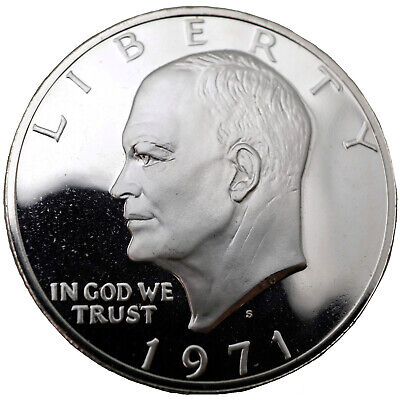
The Eisenhower Dollar was introduced by the United States Mint in 1971. It marked the first time that a dollar coin was produced by the United States Mint since the Peace Dollar series ended in 1935. The coin honors Dwight D. Eisenhower, the 34th President of the United States, and the design also commemorates the 1969 moon landing.
Design and Specifications
The obverse of the Eisenhower Dollar features a profile portrait of President Dwight D. Eisenhower, designed by Frank Gasparro. The reverse design, also by Gasparro, depicts an eagle landing on the moon, echoing the insignia of the Apollo 11 mission. The coin was initially produced in two compositions: a copper-nickel-clad version intended for circulation and a 40% silver-clad version aimed at collectors.
| Specification | Details |
|---|---|
| Diameter | 38.1 mm |
| Weight | 22.68 grams (copper-nickel), 24.59 grams (silver) |
| Edge | Reeded |
Production and Distribution
The Eisenhower Dollar was minted from 1971 to 1978. The coins were produced at the Philadelphia, Denver, and San Francisco Mints. The copper-nickel versions were intended for general circulation, but due to their large size and weight, they were not widely used in everyday transactions. The 40% silver versions were produced in limited quantities and sold to collectors at a premium.
Collectibility
While the Eisenhower Dollar was not popular in circulation, it has found a place among collectors. The series includes several interesting varieties and errors, such as the 1972 Type 2 reverse and the bicentennial issues of 1975-1976. Collectors often seek these coins for their historical significance and unique designs.
- U.S. Mint: Eisenhower Dollar History
- Coin World: Eisenhower Dollar Series
- PCGS: Eisenhower Dollars
- NGC: Eisenhower Dollars
- JM Bullion: Eisenhower Dollar Information
Bicentennial Issues
In 1975 and 1976, the Eisenhower Dollar featured a dual date of “1776-1976” commemorating the United States Bicentennial. The reverse design was changed to feature the Liberty Bell superimposed over the moon by Dennis R. Williams. These coins were produced in both copper-nickel and 40% silver versions.
End of Production
The production of the Eisenhower Dollar ended in 1978. In 1979, the Susan B. Anthony Dollar was introduced, which was smaller and intended to be more practical for everyday use. The Eisenhower Dollar remains a unique and exciting series for collectors and numismatists.
Conclusion
The Eisenhower Dollar represents a significant period in U.S. coinage history. While it was unsuccessful in circulation, its commemorative designs and historical context ensure its place in collections. Collectors appreciate the series’s ties to President Dwight D. Eisenhower and the historic Apollo 11 mission.
Collecting Varieties and Key Dates
Eisenhower dollars offer numerous varieties for collectors to pursue. The 1971-S dollar is a key date with a lower mintage, and the 1976 bicentennial reverses are popular among date collectors. Some varieties involve subtle differences in die characteristics. Building a complete date and mintmark set provides an achievable goal for most collectors without requiring extreme financial commitment.
Value Guide and Collector Demand
Circulated Eisenhower dollars typically trade near face value to modest premiums depending on date and condition. Uncirculated examples and those with special finishes command higher prices. The 1971-S and 1976-S proof dollars are particularly sought after. As collectors continue to rediscover this series, demand for quality examples remains steady, making Eisenhower dollars an accessible collecting field.
Leave a Reply